

What is a web app?
A web app, short for web application, is a tool that runs in your browser. Think of it as a website, just a little fancier. Instead of only presenting information for you to read, a web app lets you do something: book an appointment, fill and submit a form, track a list, calculate a price, log in to a personal space. If a website's job is to be seen, a web app's job is to work.
That's the whole definition. And here's the fun part: you already know web apps well. You've been using them for years, happily, without anyone ever handing you the word.
You've been using web apps all along
When you check your email in a browser, that's a web app. When you log in to your online banking and move money between accounts, that's a web app. The portal where you file your taxes, the page where you booked your last dentist appointment, the form where you RSVP'd to a wedding: web apps, every one of them.
Nobody gave you a definition because you didn't need one. You typed, tapped, submitted, and the thing did its job. The concept was never the barrier. The word just hadn't introduced itself yet.
What's new is that the word is about to matter, because for the first time, making one of these is something regular people can do. More on that in a minute.
Website vs. web app: the difference in plain terms
The line between the two can feel blurry, since both live in a browser and both have an address you can visit. The distinction is what happens when you get there.
A website presents information: you read it, browse it, watch it, and it shows every visitor the same thing. A restaurant's menu page, a company's About page, a blog article like this one, all websites. A web app gets something done: you type into it, submit things, interact with it, and it responds to you specifically. A booking calendar, an order form, a client portal, all web apps.
The restaurant makes it concrete. Its website shows you the menu and the opening hours. Its web app takes your reservation for Friday at 7. Same restaurant, same browser, fundamentally different jobs. Most businesses eventually want both, which is why the two are usually stitched together: a website to be found, with web apps doing the actual work behind the buttons.
Web apps you could build yourself
Every example so far has one thing in common: someone else built it, and you were the person using it. Here's the shift worth noticing. A web app can also be something you make, for your clients, your members, your family, your people. Some of the most satisfying ones are exactly that:
A booking page for your salon, where clients pick their own time slot in a couple of taps, and the appointment lands in your calendar all by itself.
An order form for your weekend baking, so every birthday cake request arrives as one tidy submission, flavour, date, and allergies included.
A mini-CRM for your freelance work, a simple place that remembers every lead, every "circle back in the fall," and every invoice, so you don't have to.
A trip planner for the family vacation, where the flights, the rental confirmation, and everyone's one must-do activity live together on a single page the whole family can see.
A class schedule for your fitness studio, where members grab their spot in Tuesday spin themselves and the waitlist moves people up automatically.
A quiz for first-time visitors, so "which service is right for me?" gets a friendly, personalized answer in four taps.
Notice the pattern: each one takes something you do by hand, over and over, and turns it into a small tool that handles it for you. That's the essence of a web app at any size, from a solo baker to a busy agency. Less "software product," more "a little helper you built yourself."
Why this term matters now
For most of the internet's history, this distinction was academic for regular people, because you couldn't build either one yourself, and a web app least of all. A website could at least be assembled from ready-made pieces. A web app needed a developer, because it has moving parts: forms that submit somewhere, schedules that update, logins that remember who you are. Moving parts meant code, and code meant a developer.
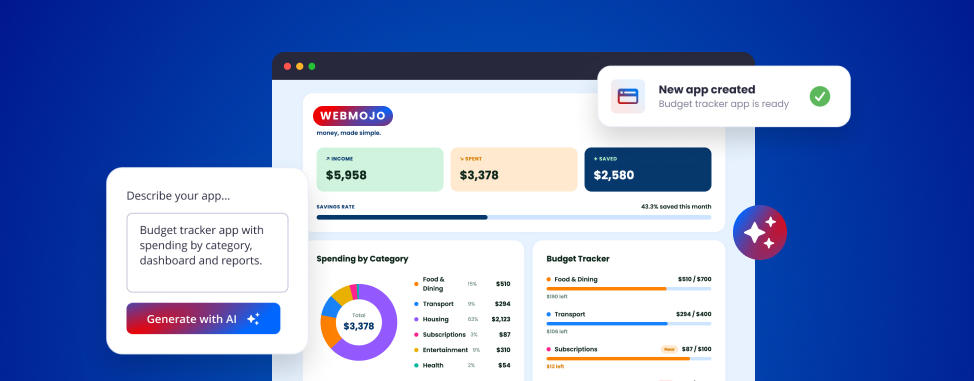
That's the part that changed. AI builders like WebMojo can now generate a working web app from a plain-language description, in English or in French, in about two minutes. You describe what you have in mind, you get a working version you can try immediately, and you refine it by typing what to change, the way you'd brief a very fast and very agreeable collaborator. The moving parts arrive already moving.
Which is why the vocabulary is suddenly worth having. "I need a website" and "I need a web app" used to lead to the same shrug. Now they lead to different tools, and knowing which one you need is the first step to getting it.
Quick answers
What's the difference between a web app and a mobile app? A mobile app is downloaded from an app store and installed on your phone. A web app runs in the browser on any device, phone included, with nothing to install. You open it with a link, like a website.
What's an example of a small web app? It doesn't even have to be for business. A chore rotation tracker for your apartment, a tip-splitting calculator for poker night, a signup page for the street barbecue, a watering schedule your plants would thank you for. If it does a small job for you, it qualifies.
Can a web app be part of my website? Yes, and it usually is. The website presents your business, and the web app does the work behind the buttons: the booking calendar, the quote form, the login area.
Do I need a developer to build a web app? Not anymore. AI builders like WebMojo generate a working web app from a plain-language description in about two minutes, and you refine it by typing what to change.
How much does it cost to build a web app? With an AI builder, you can start free. WebMojo includes five free prompts with no purchase required, and paid plans start at C$11.99 per month.
Try the idea on
A quick exercise: think of one thing in your week you'd love to hand off to a helpful little tool. The question you answer over and over, the schedule everyone keeps asking about, the requests you'd rather receive in one tidy form. There's a good chance what you're picturing isn't a website at all. It's a small web app waiting to exist.
WebMojo, offered by WHC, builds web apps and complete websites from a plain-language prompt, and you can try it free with five prompts, no credit card. Describe it in a sentence, and see what comes back.
WebMojo uses AI to generate websites and web apps. AI-generated content and layouts may be similar or identical to those created for other users.
 About the author: Claudia Bouchard
Claudia is a Marketing Specialist at WHC. She keeps marketing projects on track and makes sure product launches are set up for success. When she's not working, she's probably at a new restaurant, enjoying the sunshine, or somewhere with good company.
See all articles from this author Interested in writing for Web Hosting Canada?
Also on the WHC Blog

10 web hosting questions people keep asking, answered honestly
Finding the right hosting for your website or project shouldn't eat your whole weekend. Most of it comes down to a few real questions, the same ones that come up over and over here and in other hosting threads. Here are straight...
Read full article
The internet is scrambling to patch a critical PHP flaw. If you’re hosted with WHC, you’re not.
Last updated: October 22, 2026 A critical security vulnerability in PHP, the software that runs most of the websites on the internet, is making headlines across Canada and around the world. If your website is hosted...
Read full article
