

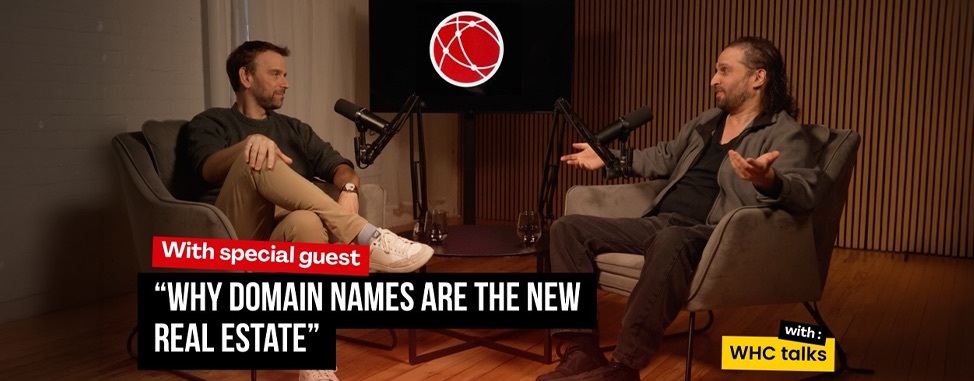
How to spot a domain name worth buying (with investor Arif Mirza)
Recently, the domain AI.com sold for $70 million, one of the largest sales on record. Icon.com went for $12 million around the same time.
You're never going to spend that, and you don't need to. But those sales prove a point that applies to your .ca just as much: a domain isn't an address, it's an asset. The best ones hold value, and the best ones get taken fast. So the real skill isn't spending big. It's knowing how to spot a name worth owning before someone else does.
If you haven't come across it yet, WHC Talks is our podcast video series where we sit down with Canadians who really know their corner of the web, from domains and hosting to building a business online, and dig into the practical stuff entrepreneurs can actually use. Each episode tackles a different topic, and this one is all about domain names.
In this episode, our CEO Emil sits down with Arif Mirza, the Montreal-based domain investor behind DomainPodcast.com. Arif has spent nine years in the game and holds a portfolio of more than 5,000 domains, so when he talks about what makes a name valuable, it's worth leaning in.
The conversation is built for Canadian entrepreneurs and anyone curious about domains, whether you're registering your very first .ca or wondering how domainers turn a small registration fee into a serious sale.
A few things you'll learn
What a domain name actually is. It's the address people type to reach you (the yourbusiness.ca part), and usually the first thing someone learns about your brand. It isn't just a technical detail. It's digital real estate you own and build equity in over time, which is exactly why the choice deserves more thought than most people give it.
The radio test. Say your domain out loud, and if the other person can't spell it back to you, it's not the right domain. A good domain survives word of mouth. No hyphens to explain, no "is that a zero or an O". If people can't type it correctly after hearing it once, you're quietly losing visitors every day. (If you're at the naming stage right now, our guide on how to choose the right domain name pairs well with this one.)
A 3-category framework for judging any domain. As an investor, Arif sorts every domain into one of three buckets:
- “Garbage”. Too long, hard to spell, or without any real meaning. Not worth your money.
- Good enough to start with. Not perfect, but solid enough to launch a business on and grow into.
- Investment quality. Short, snappy and memorable, or a longer phrase that still sticks and means something for a business. Arif's sweet spot here is what he calls "bread and butter" domains: two words that pair well, easy to remember, not too long. A geographic angle works nicely (think Montreal plus a keyword, like montrealmovers.ca), and so does a catchy keyword paired with a word tied to the business. A bit of alliteration or rhyme makes a name even harder to forget.
Why your email address might be quietly costing you deals (and hurting your credibility). That [email protected] address feels harmless. A matching address ([email protected]) looks more established, is easier to remember, and reinforces your brand every single time you hit send. We went deeper on this one, in how your email address is hurting your business.
Why choosing local can actually save you money. Here's one that surprises people. Registering your domain through a Canadian company, in Canadian dollars, can cost you less than going through a US provider. You skip the currency conversion and the foreign exchange fees that quietly pad the price when you're billed in USD, and you get support in your own time zone on top of it.
Why .ca is a smart move for Canadians, and how our .CA domain auctions let you find, search, and bid on recently expired .ca names before they return to open registration. A .ca also tells your customers you're Canadian, which builds trust locally. If you're weighing your options, our take on .ca vs .com breaks down when each one makes sense.
Are domains actually a good investment?
For the right names, yes. Domainers often call domains digital real estate, and the comparison holds up: there's only one of each, the best addresses are already owned, and scarcity pushes the good ones up in value over time.
The headline sales make the point. In 2025 alone, Icon.com sold for $12 million, Commerce.com for $2.2 million, and names like Derm.com ($825,000) and ABTC.com (just under $700,000) changed hands on the aftermarket. And those are only the public ones. Most big domain deals happen quietly under NDA, so the real market is bigger than the headlines suggest.
Here's the part that matters for regular business owners. Plenty of those names started as ordinary registrations. Domainers buy or register names a business will likely want down the road, then resell them later. Arif explains why he sees domains as a stronger long-term digital investment than crypto or NFTs: unlike a speculative token, a domain has real-world value because it's something businesses and individuals actually need to build and grow online.
He'd know. As he puts it in the episode:
"I bought domains for $5 that I've sold for $5,000. I bought domains for $50 that I've sold for $10,000."
From those early flips to the moment he nearly walked away from it all, Arif shares the honest version of domaining, not the hype version.
The good news is you don't need a seven-figure budget to start. In Canada, most .ca names on the aftermarket cost a few hundred dollars, occasionally more.
Why we wanted to have this conversation
At WHC, we help Canadians get online every day, and the domain is often where it all starts. Getting that first decision right saves you from the painful (and expensive) rebrand down the road. Arif's perspective, built over nearly a decade and thousands of names, is exactly the kind of practical, plain-language advice we like to put in front of our community.
Ready to find your dream domain?
If the name you want is already taken, don't give up on it. A lot of great .ca domains free up every week as registrations expire, and that's exactly what our auction platform is built for. You can search what's available, place your bid, and pick up a name that would otherwise be out of reach. That's how you land an established .ca domain, sometimes at a real bargain, before anyone else spots it.
👉 Explore our .CA domain auctions to get in the action and start investing
Frequently asked questions
How much do domain names sell for? Most domains register for the price of a coffee, but the aftermarket is another story. The average secondary-market sale runs into the thousands, and premium names regularly sell for tens or hundreds of thousands, sometimes millions. In Canada, most .ca names on the aftermarket land somewhere between a few hundred and a few thousand dollars.
Can you make money buying and selling domain names? Yes. It's a real practice called domain investing (or flipping). Investors register or buy names they expect a business will want later, then resell them. It takes research and patience, and most names won't be home runs, but the model is legitimate and the market is active.
How do .ca domain auctions work? When a .ca domain expires, it eventually gets released and becomes available again. Our .CA domain auctions let you bid on these recently expired names before they return to open registration, so you can land an established .ca domain (sometimes at a bargain) before anyone else.
Can I buy and sell domains through WHC? Buying, yes: register a new domain, or bid on expired .ca names in our auctions. Selling your own domain isn't live yet, but a full aftermarket section is on the way.
Catch the rest of WHC Talks
This episode is part of our WHC Talks series. You'll find the full playlist on YouTube.
 About the author: Marine Nolf
Marine is the Marketing Specialist and Affiliate Manager at WHC, where she supports marketing initiatives, manages partnerships, and represents the company at events. In her spare time, you can find her exploring Montreal, baking cookies, or volunteering in animal shelters.
See all articles from this author Interested in writing for Web Hosting Canada?
Also on the WHC Blog
Your WordPress site just got safer, automatically
The short version: Security threats keep evolving, and in the age of AI they move faster than ever. To stay ahead of them, we've added a new security tool to every WordPress site hosted at WHC. It's installed and working...
Read full article
A Clearer, Faster Way to Get Support at WHC
When something's not right with your website or email, you shouldn't have to figure out how to reach us. Help should be easy to find and easy to get… whatever the hour. This is why we've just made a change we're genuinely...
Read full article
